Poco X8 Pro Max review
Display
Xiaomi practically never skimps on display, even in its lower-tier offerings, and the Poco X8 Pro Max is definitely not among those. It has a large 6.83-inch, 12-bit AMOLED display with a 2772 x 1280 pixel QHD+ resolution and a 120Hz refresh rate.

It is very sharp in person and also advertised as very bright with 2,000 nits max on the entire screen and 3,500 nits peak on 25% screen area. The minimum brightness at point white is 2.0 nits.
And circling back to brightness for a second, the Poco X8 Pro Max supports 3840Hz PWM dimming. There seems to be no option for DC dimming. Other than that, the phone also has a few TÜV Rheinland certifications, including Low Blue Light with a hardware solution, Flicker Free Certified and Circadian Friendly Certified, whatever that means.
We did our standardized max brightness testing and measured around 840 nits by maxing out the manual slider with the extra brightness toggle turned on. Turning it off only yields about 690 nits.
In auto brightness mode, we got a perfectly respectable 1,114 nits in a 75% window and 3,527 nits on a 10% window. We never struggled to see the phone outdoors, which is the important bit, and there is plenty of brightness here for an excellent HDR experience.
Max display brightness test
White test pattern (nits)
- Manual (75% fill)
- Auto (75% fill)
- Peak Auto (10% fill)
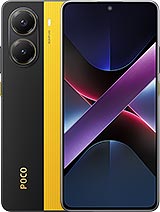
 vivo V70
 Galaxy A56
 Poco X6 Pro
 Poco X8 Pro Max
 Poco F8 Pro
 Poco X8 Pro
 Poco F8 Ultra
Speaking of HDR, the Poco X8 Pro Max has both Dolby Vision and HDR10+ certifications. It can decode all the popular HDR video formats, including Dolby Vision, HDR10, HDR10+ and HLG. For HDR photography, the phone supports Xiaomi's own Pro HDR and can also properly display Google's UltraHDR standard. There is also the highest possible Google Widevine L1 DRM certification, allowing streaming apps like Netflix to offer up FullHD streams.
The Poco X8 Pro Max has a 120Hz refresh rate. Also, an up to 480Hz touch sampling rate and a 2560Hz instant touch sampling rate. The phone uses an LTPS panel, so don't expect very dynamic or granular refresh rate adjustment. Still, the display can go down to 30Hz. It only seems to do so in the lock screen, but the mode is there, along with 60Hz, 90Hz and 120Hz. There are two modes to choose from in settings - Default and Custom.

Default offer automatic refresh rate switching. Most apps run at 60Hz or 90Hz, and the refresh rate only jumps up to 120Hz when you interact with the display or when there is some animation happening. Video apps tend to get locked to 60Hz, which is good. The Custom refresh rate mode lets you either lock the phone to 60Hz or choose on a per-app basis which apps get to go up to 120Hz and which should stick to a 60Hz cap. We tried some games we know can push past the 60fps point, and most of these successfully ran in the 120Hz mode, with just a few exceptions, making high-refresh-rate gaming on the X8 Pro Max very feasible.
Battery life
The battery is clearly one of the highlights of the Poco 8 Pro Max. It's a huge 8,500 mAh battery on board with modern Si/C chemistry. Apparently, in India, the battery is even bigger at 9,000 mAh. With its current chipset manufactured on a 3nm node, we expected nothing short of excellent battery life.
And the Poco X8 Pro Max definitely delivered. In our testing, it managed an exceptional Active Use Score of 25:22 hours. The online video streaming test result, in particular, was very impressive. In fact, with its overall score, the X8 Pro Max takes the second spot in our current all-time best chart, sitting just a notch below the Realme P4 Power, which has a whopping 10,000 mAh battery, and it even tops the Realme's video streaming runtime.
Charging speed
A battery as huge as the one inside the Poco X8 Pro Max kind of necessitates fast charging, and here we have support for Xiaomi's excellent 100W charging. Xiaomi uses its own proprietary charging protocol, and technically, the official charger is also quite proprietary, seeing how it uses a 6A USB Type-A to Type-C cable (which you do get in the box). /p>

The actual charging rate we measured doesn't sound overly impressive, with 37% charged in 15 minutes, 65% in 30 minutes and a full charge taking 52 minutes. Still, you have to remember just how big a battery we are charging here.
Charging speed
- in 15 min
- in 30 min
- Time to full charge (from 0%)
 Xiaomi 15T Pro
Poco X8 Pro
Galaxy A56
Poco X8 Pro Max
 Galaxy S25 FE
vivo V70
 Redmi Note 15 Pro 5G
In terms of battery health features, you get a standard set of options. That is to say, your typical charge limiter. You can either set a hard 80% charge cap or let an intelligent system decide when it is appropriate to charge up to 100% automatically.
Speakers - loudness and quality
The Poco X8 Pro Max has a symmetrical stereo speaker setup. That means two full-fledged speakers, one firing up and another firing down. While this inevitably means that you can more easily cover both speakers with your palms when holding the phone horizontally, it also makes for a much more balanced audio output overall.

Quality-wise, the output is pretty clean. You get a nice and rich sound stage. Clear mids, decent highs and about as much bass as one can expect from your average smartphone speaker these days, which is not a lot.
The Poco X8 Pro Max can get very loud. Xiaomi offers the option of boosting the speakers to 400%. If you care about quality, however, we recommend against going past 100%. Highs get really distorted and tinny. Still, we made sure to measure the maximum loudness in 400% mode, and the sample recordings below and the audio quality chart are at 100% volume. At 100% volume we measured a loudness of -26.7 LUFS.
The phone supports Dolby Atmos optimization with a full graphical equalizer with presets and sliders. Alternatively, if you are not a fan of Dolby, you can use Xiaomi's own audio engine instead. There are also Hi-Res Audio and Hi-Res Wireless Audio certifications. Plus, support for SBC, AAC, LDAC, LHDC 5.0, LC3, ASHA and Auracast codecs.
Use the Playback controls to listen to the phone sample recordings (best use headphones). We measure the average loudness of the speakers in LUFS. A lower absolute value means a louder sound. A look at the frequency response chart will tell you how far off the ideal "0db" flat line is the reproduction of the bass, treble, and mid frequencies. You can add more phones to compare how they differ. The scores and ratings are not comparable with our older loudspeaker test. Learn more about how we test here.
Connectivity
The Poco X8 Pro Max is a 5G device with simultaneous SA/NSA Sub-6 connectivity on both of its Nano-SIM slots. It also has eSIM support, but you can still only have two active concurrent network connections at a time. For location, the phone has quad-band GNSS (GPS, QZSS, BeiDou, Galileo, Glonass, NavIC). Local connectivity is covered by dual-band Wi-Fi 7. Unfortunately, while you do get some of the new protocol benefits, there is no support for the still largely unutilized 6GHz band here. The Wi-Fi setup is 2x2 MIMO and 8x8 Sounding for MU-MIMO.
Bluetooth is version 6.0 with LE support. There is NFC on board and an IR blaster. The latter is actually the second small element below the LED flash on the back of the phone, so it's not particularly hidden. No 3.5mm audio jack, no FM radio and no SD card slot, though.

The Type-C port is backed up by a USB 3.0/3.1 Gen 1/3.2 Gen 1 connection. That means a theoretical data throughput of up to 5 Gbps. Not too shabby. Beyond that, there is nothing fancy like video output over USB Alt mode. Of course, you get OTG/Host support. There is an OTG toggle in settings, which is a thing on some phones. Keeping it off doesn't disable OTG functionality, though, turning it on just "expands compatibility," which, as far as we understand it, just means providing more power to the port for accessories.
There is a pretty good set of onboard sensors. The Poco X8 Pro Max gets an st slm6dsvq accelerometer and gyroscope combo, a qst qmc6308 magnetometer and compass combo and an ams tsl2525 light sensor. The proximity sensor is unfortunately not a hardware one, but rather a virtual solution from Elliptic Labs. That said, it does a fairly good job of turning off your display during calls. There is no barometer.


Tip us
2.1m 180k
RSS
EV
Merch
Log in I forgot my password Sign up