Xiaomi 17 Ultra Leica Edition review
1.0" main camera, continuous zoom telephoto
The Xiaomi 17 Ultra's camera system is well worthy of its name, packing industry-leading imaging hardware. The Leica edition we have here takes that a step further still, with a functional rotating ring around the camera island and a few software enhancements.

Starting with the main camera on the back, the 17 Ultra still features a 1.0" type sensor - these have been slowly disappearing, but Xiaomi is persisting. It's a new sensor too, the Light Fusion 1050L (which is reported as OmniVision OVX10500 in hardware apps) replacing the Sony imager of old. The basics are the same though, so it's still got a 50MP nominal resolution and a stabilized 23mm-equivalent lens.
The other major development is the shift from two telephoto cameras to a single one. That single new camera will cover both of the old ones' focal lengths, and all the others inbetween - it's got continuous coverage in the 75mm to 100mm range. It's not a huge range, no, but it's certainly more versatile than having only one of the focal lengths.
It's apparently a new version of the Samsung 200MP 1/1.4" sensor that's behind that most impressive periscope - the HPE moniker that is being reported doesn't return any Samsung product pages yet. Still, you get that sensor at 4.3x zoom, as before, but also at 3.2x, where the old model had a 1/2.51" sensor - not a bad development. Close focusing has suffered though - a not insignificant price to pay, though there may be workarounds for macro-style shooters.

The ultrawide camera is seemingly unchanged - both the sensor and the lens specs are the same as before.
Over on the front, there's another new piece of kit - a 50MP selfie camera has replaced the 32MP unit we've been getting on all too many Xiaomis. The new module also has AF capability, a long overdue development.
- Wide (main): 50MP OmniVision OVX10500 (1.0", 1.6µm-3.2µm); 23mm, f/1.67, OIS, multi-directional PDAF (14cm - ∞); 8K30/4K120 video recording.
- Telephoto: 200MP Samsung ISOCELL HPE (S5KHPE, 1/1.4", 0.56µm-2.24µm); 75-100mm, f/2.39-2.96, OIS, PDAF (26cm - ∞); 8K30/4K120.
- Ultrawide: 50MP Samsung ISOCELL JN5 (S5KJN5, 1/2.76", 0.64µm-1.28µm); 14mm, f/2.2, multi-directional PDAF; 4K60.
- Front camera: 50MP OmniVision OV50M (1/2.88", 0.61µm-1.22µm); 21mm, f/2.2, AF; 4K60.
The 17 Ultra comes in two versions, a regular one, and one that's called 'Xiaomi 17 Ultra by Leica' - that's the one we have here. Xiaomi's partnership with the German optical glass company (that also happens to make cameras) goes way back, but this is the first time we're seeing it taken to that 'by Leica' level.
 'Xiaomi 17 Ultra by Leica' comes with retro themed accessories too
There are physical differences between this version and the regular 17 Ultra. The frame finish on the Leica edition is ribbed and provides better grip, while the rear's two-tone design evokes comparisons to old-timey rangefinders. There's another thing as well - a rotating ring around the camera island that can be used to launch the camera app and do things inside it.
It's highly customizable and you can set its sensitivity for opening the camera app or you can disable that bit entirely. When inside the camera app, you can assign a different function for each camera mode, so it can be smooth zoom in video and exposure compensation in photo mode, for example. While the ring operation is entirely electronic, the phone's vibration motor provides nice haptic feedback.
We'll admit it's a novel take on smartphone camera control and we like it for that, but we also often found ourselves nudging it accidentally and going to 1.3x zoom or -1/3EV, or something - perhaps a stiffer action would have been better. That said, we can see it being particularly useful for operation with gloves for example.

Xiaomi (and Leica) chose not to fit a shutter release button/key on the 17 Ultra like many of the other high-end cameraphones have. If there's going to be a ring, why not a key too, for ultimate manual control capabilities? Plus, the non-Leica 17 Ultra is left with no extra controls - being ring-less and all.
The 'by Leica' version also features a dedicated chip that will ensure that its images get signed and authenticated as 'real' as opposed to AI generated according to the Content Authenticity Initiative (CAI)'s guidelines.
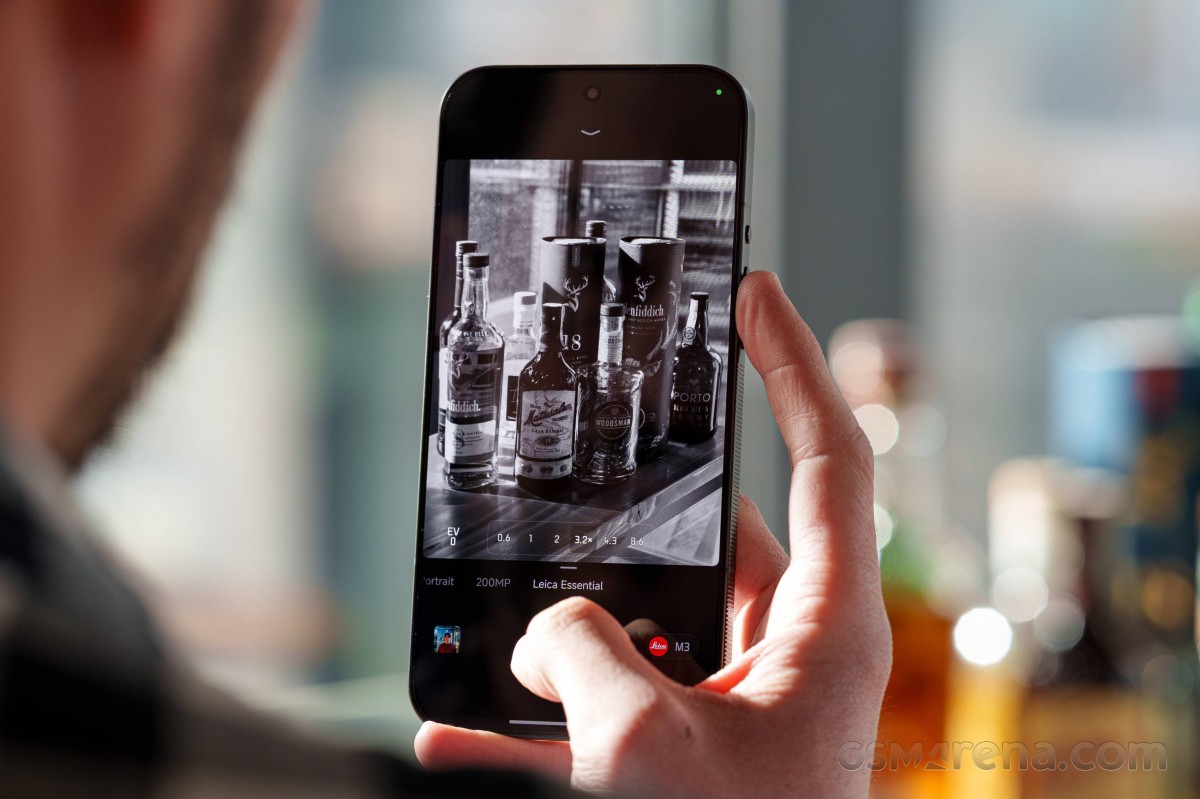
Another exclusive feature to this version is the Leica essentials mode, that has two image filter/style presets - one emulates the look of the Leica M9's images, the other mimics the Leica M3 with Monopan 50 black and white film. That's in addition to the Leica Vibrant and Leica Authentic main styles and a ton of other filter presets accessed from different corners of the viewfinder, which are standard for all Xiaomi 17 Ultras (not just the Leica version).
Daylight photo quality
Main camera
The main camera of the Xiaomi 17 Ultra is quite probably the best of its kind. It captures excellent detail and renders it with a nice crispiness that still looks natural. There's no noise to speak of either, of course. The auto white balance is consistently on point and colors are vibrant, yet 'photographic' as opposed to cartoonish.
Dynamic range is very wide, which is normally a great thing. In this case, and we observed it to some extent on all of the Ultra's cameras, there's a bit of a tendency in some contrastier scenes to flatten the image. That's the closest to being an issue that we can think of, and while we would appreciate a bit more contrast on those occasions, we wouldn't really call it a problem.












Daylight samples, main camera (1x)
People shots are looking great too. Skin tones are neutral and facial detail is rendered well. There's a decent amount of subject separation from the lens, but you can opt for the Portrait mode's added background blur.








Human subjects, main camera (1x): Photo mode • Portrait mode
The main camera's nominal 50MP resolution isn't just for the specsheet - the full-res images can actually be good, provided you have plenty of light in the scene (and not too much contrast).








Daylight samples, main camera (1x), 50MP
With that in mind, it shouldn't be a surprise that 2x zoom shots are also excellent. Even in situations where the 1x 50MP photos weren't too hot, the 12.5MP 2x zoom images are nicely sharp and detailed. Even random detail has a natural rendition.












Daylight samples, main camera (2x)
Portraits at 2x zoom are every bit as detailed as those shot at the camera's native focal length. As usual, the perspective is better for head-and-shoulders framing at this zoom level than at 1x.








Human subjects, main camera (2x): Photo mode • Portrait mode
Telephoto camera
The shorter end of the new continuous zoom telephoto replaces the older 3x camera and we'd say it does it effortlessly - you won't be missing the previous solution outside of very specific closeup scenarios. Detail is superb, dynamic range is excellent, colors are great.
















Daylight samples, telephoto camera (3.2x)
The 75mm focal length is well suited for portraits too. The images have excellent detail and skin tones, alongside nice optical-level background blur that renders Portrait mode more or less unnecessary.








Human subjects, main camera (3.2x): Photo mode • Portrait mode
The 50MP shots are top notch too - in outdoor scenes in particular you can extract some meaningful extra detail in foliage or other random textures. Justifying the 200MP mode's file sizes will be more difficult though - while not exactly soft, these images don't necessarily bring any detail on top of the 50MP ones.




Daylight samples, telephoto camera (3.2x), 50MP




Daylight samples, telephoto camera (3.2x), 200MP
At the long end of the optical zoom range, we get 4.3x 100mm equivalent shots that are just as good as the 3.2x ones.
















Daylight samples, telephoto camera (4.3x)
Similarly, the 100mm portraits are as good as the 75mm ones, but this end of the zoom range is better suited to tighter framing and situations where some extra compression is desired.








Human subjects, main camera (4.3x): Photo mode • Portrait mode
For completeness sake, here's a set of 50MP and 200MP photos at the 4.3x zoom level, but don't expect to find anything new there - 50MP is great, 200MP is meh.




Daylight samples, telephoto camera (4.3x), 50MP




Daylight samples, telephoto camera (4.3x), 200MP
Here's a quick comparison of a few scenes shot at the two intermediate presets (3.7x/85mm and 3.9x/90mm) as well as the two extremes of the zoom range. We wouldn't say there's a noticeable difference in quality.








Daylight samples, telephoto camera: 3.2x • 3.7x • 3.9 • 4.3x
From inbetween zoom levels, to some digital zoom at 8.6x (or is that 'in-sensor lossless zoom'?). You can expect solid 12.5MP images - these are essentially the same on a pixel level as the 50MP 4.3x shots, but potentially with better tuned exposures.
It's worth pointing out that the 17 Ultra is meaningfully better at this level than the 15 Ultra - the new model also has an advantage at 4.3x, but it's a little less pronounced there.








Daylight samples, telephoto camera (8.6x)
Tapping on the 8.6x button will take you to 17.2x which is a 400mm equivalent focal length. It's only here that quality drops noticeably, but the photos remain usable - possibly even good, depending on what you're going to do with them.






Daylight samples, telephoto camera (17.2x)
Ultrawide camera
Going from 400mm to 14mm, we're looking at photos from the 17 Ultra's ultrawide camera. The ubiquitous JN5 sensor punches above its weight here, maybe thanks to a pairing with an unusually good lens, but either way the ultrawide photos are sharper than what we'd expect from similar hardware. Colors and dynamic range are excellent too.











Daylight samples, ultrawide camera (0.6x)
The full-res shots are noticeably softer, and if you were to resize them to 12.5MP, you'd get worse results than the ones above.




Daylight samples, ultrawide camera (0.6x), 50MP
Close-ups
One potential drawback to the single-tele approach of this year's model vs. the 15 Ultra's setup is that the 17 Ultra's telephoto can only focus as close to 26cm (weirdly enough, that goes up to 30cm in Pro mode), whether at 3.2x or at 4.3x. In contrast, the 15 Ultra's shorter tele could focus as close as 9cm away from its lens. So technically, the old model would have been a better option for 'macro' shooting.
The thing is, though, that the 17 Ultra's telephoto might just be getting better results at 8.6x zoom at 26cm than the old one could at 3x zoom with subjects 9cm away. Also, the 2x performance of the main camera is good enough to make it another viable option for closeups. Of course, even closer focusing on the telephoto would be greatly appreciated.




Close-up samples, main camera (2x)




Close-up samples, telephoto camera (3.2x)
Close-up samples, telephoto camera (4.3x)




Close-up samples, telephoto camera (8.6x)
Selfies
Another major development this year is the selfie camera, which has now been upgraded to use a 50MP sensor (up from 32MP) and also, finally, gets autofocus. Indeed, it generally produces very good photos and is particularly adept at closeups - it actually shines there. Still, it's not a big fan of harsh sunlight or dim lighting (we're talking daytime indoor shots, not low-light photos), so while it is a step up, it still leaves room for improvement.








Selfie samples
Low-light photo quality
Main camera
In the dark, the main camera is about as good as you can get today. The shots are sharp and detail, with no obvious night mode softening/oversharpening action - clear lines,no noise, texture where there should be texture. Dynamic range is excellent and exposures are well balanced, the white balance is spot-on and color rendition is great. Now, that pretend-neon sign is obviously heavily restored and it could have been left to burn out a little, but that's about as niche as a complaint as it gets.












Low-light samples, main camera (1x)
The 17 Ultra is actually remarkably good at 2x as well - in takes its daytime 2x excellence into the night in a way that we haven't seen others do, neither the recent Pros, nor the latest batch of Ultras. Top stuff.










Low-light samples, main camera (2x)
Telephoto camera
The telephoto won't be letting you down either. Again, you can count on excellent dynamic range with well preserved highlights and very good shadow development, with top-class detail in the well-lit areas (and somewhat selectively softer shadows). Colors are great too, of course.












Low-light samples, telephoto camera (3.2x)
Things are more or less identical at 4.3x, though there might be a little bit of added softness in the shadows, just maybe.












Low-light samples, telephoto camera (4.3x)
The 8.6x zoom level remains usable - perhaps even good, depending on the specific scene's lighting and the intended use. Well lit facades remain well developed and still have good detail but darker areas can be a little mushy.










Low-light samples, telephoto camera (8.6x)
At 400mm you get more of a suggestion of a shape rather than intricate detail. Either way, zoom shots are better on the 17 Ultra than on the 15 Ultra.




Low-light samples, telephoto camera (17.2x)
Ultrawide camera
The ultrawide camera's low-light photos aren't quite as exciting as its daylight results, but things aren't half bad either. Sharpness is good, about on par with recent Oppo and vivo Pro efforts, but their respective Ultras are superior (the soon to be replaced ones, not the upcoming ones - might be obvious but it doesn't hurt pointing it out). Colors and dynamic range give no grounds for complaint, though.








Low-light samples, ultrawide camera (0.6x)
Photo quality verdict
The Xiaomi 17 Ultra is among the best phones for taking pictures currently on the market, possibly the best. It's got a superb main camera that is nearly flawless at both its native focal length and at 2x zoom, in good light and at night. The new continuous zoom telephoto is excellent at the extremes (and at the intermediate levels too, though it could have easily been two fixed stops at both ends), and the ultrawide is better than most in daylight, solid at night. The selfie camera is a welcome improvement in detail and AF capability, too.
Video quality
The Xiaomi 17 Ultra can record video up to 8K30 with all of its rear cameras. When it comes to 4K, you get up to 120fps on the main camera and the telephoto, while the ultrawide maxes out at 60fps. The selfie camera's top mode is 4K60 too.
The usual selection of h.264 and h.265 codecs is available. Dolby Vision capture is also available for all quality settings on all cameras, except for the 8K resolution modes.
There's a motion tracking AF toggle in settings (can be automatic or double-tap-to-acquire, up to 4K30 and no Dolby Vision), and there's a spatial audio capture capability. Sure enough, there's always-on regular video stabilization, and then there's a 'ShootSteady' mode up to 2.8K30.
A Pro video mode is also part of the feature set. It's got manual exposure controls, LOG recording with LUT support (4 preloaded ones and an import capability), a tiny waveform, focus peaking, and zebras. There's still no 24fps mode anywhere to be found, though.
You can check out the playlist below, which includes multiple video samples.
Daylight videos from the Xiaomi's rear cameras are very good altogether. The three cameras are well matched and produce great dynamic range and accurate colors in video. It's the sharpness that's a notch below ideal, on all three modules - not that it's bad, it's just not spectacular. Also, while stills at the 'made-up' zoom levels (2x and 8.6x) are very high quality, videos aren't quite on the same level (which is to be expected, really).






Xiaomi 17 Ultra, video screengrabs, daylight: 0.6x • 1x • 2x • 3.2x • 4.3x • 8.6x
In the dark, the 17 Ultra's main camera is doing well at 1x, though we would have expected more from its 1.0" type sensor - the Find X9 Pro, for example, has a minor edge in sharpness. The ultrawide is somewhat better in its own context, though it too is bested by the same Oppo. The telephoto is in a similar situation - solid, but not class-leading. The main and telephoto cameras manage to maintain color consistency and we'd say they're more accurate in their rendition, while the ultrawide is a little off. Dynamic range on the ultrawide is also a notch below that of the other cameras.






Xiaomi 17 Ultra, video screengrabs, low light: 0.6x • 1x • 2x • 3.2x • 4.3x • 8.6x
The always-on video stabilization is superb on the ultrawide (which shouldn't be too hard to achieve), but also pretty great on the telephoto (which is more of a feat) - footage from a standing position is well stabilized and pans are smooth and trouble-free. It's the main camera's stabilization that doesn't quite match the 17 Ultra's stature - its clips are shakier than they should be, whether you shoot them from standstill or when walking.
Video quality verdict
The Xiaomi 17 Ultra boasts wide ranging video recording capabilities, including a feature-rich Pro mode and Dolby Vision for most quality settings. The actual footage leaves a little to be desired in terms of sharpness across the board, though global properties are generally top-class. Stabilization on the main camera is a bit of a disappointment, but the ultrawide and the telephoto are rock-steady.


Tip us
2.1m 180k
RSS
EV
Merch
Log in I forgot my password Sign up