Samsung Galaxy A18 4G review
One UI 9 on top of Android 17
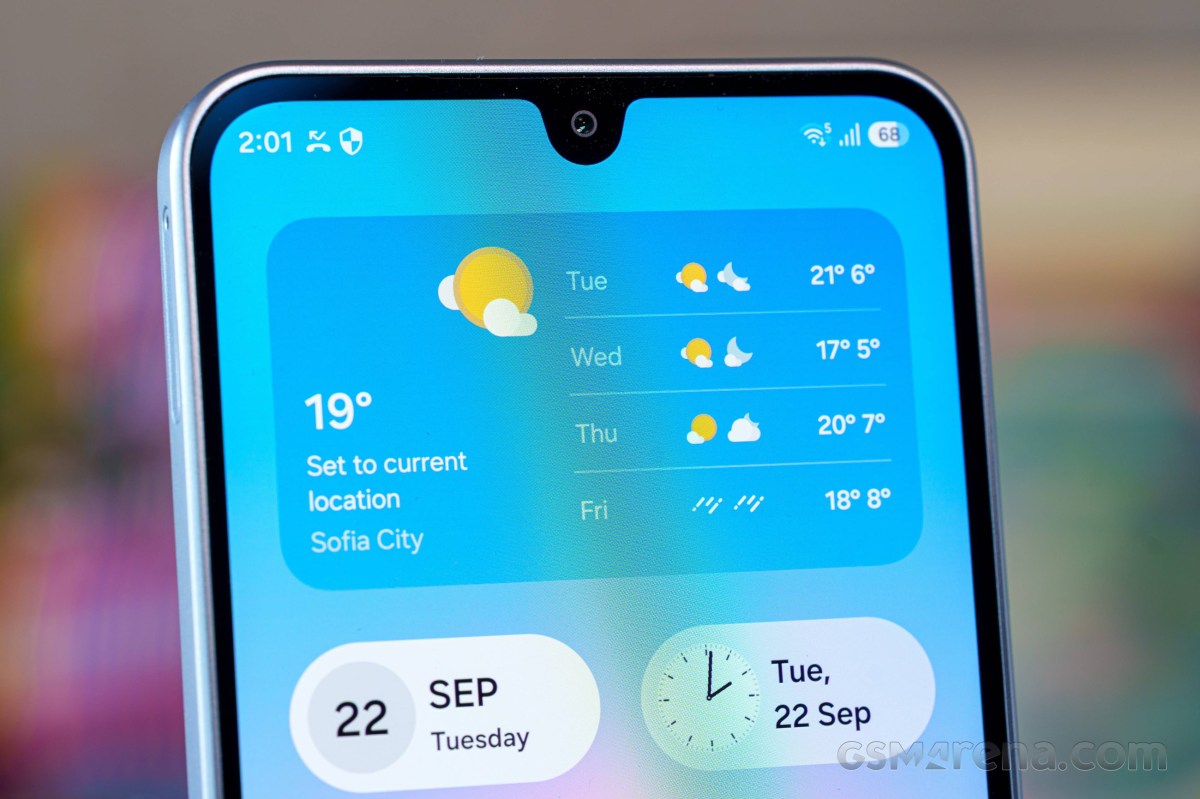
The Galaxy A18 4G launches with Samsung's latest software combo: One UI 9 on top of Android 17. Things have been moving pretty fast in the Android realm in general and I One UI in particular. For comparison, the Galaxy A17 launched on Android 15 and One UI 7.
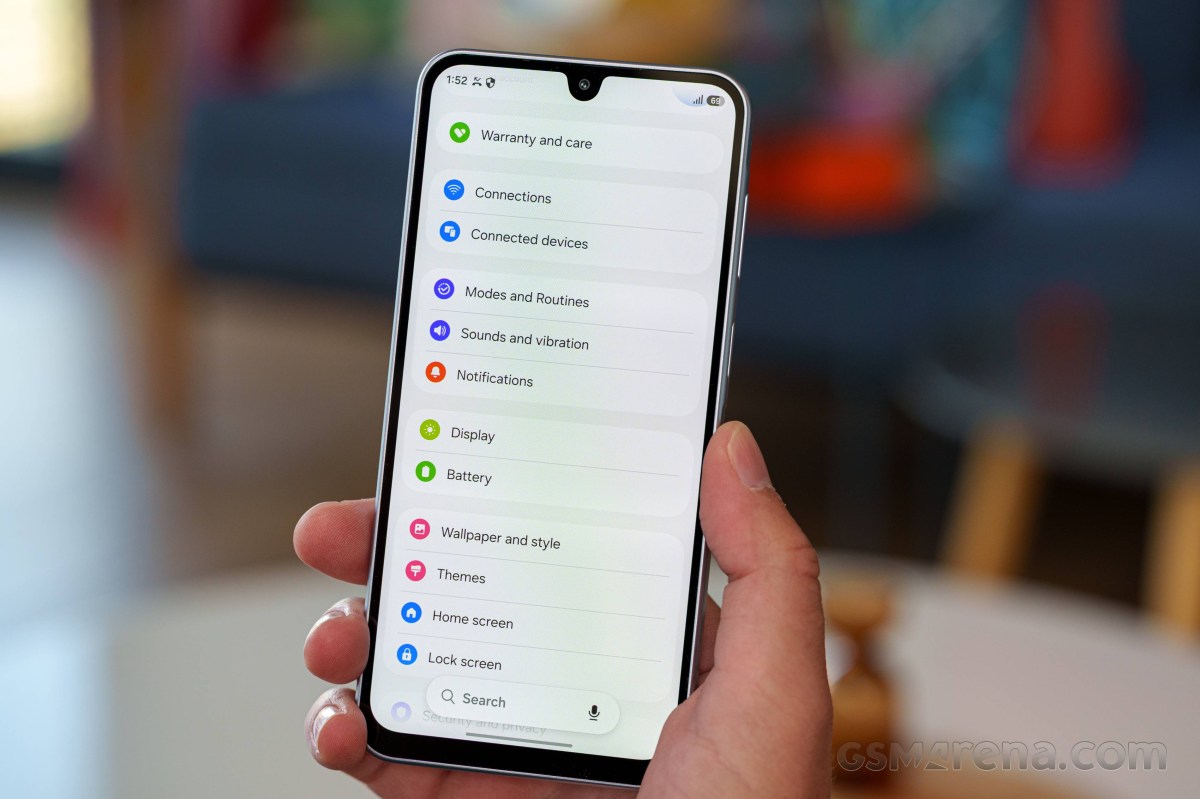
The Galaxy A18 4G comes with an impressive promise of up to six major OS updates. That might be a very strong allure for many potential buyers. Granted, we are a bit worried about the RAM situation and how well 4GB of it are going to hold up running future Android iterations. And while we wouldn't call the overall current UX of the A18 4G sluggish, laggy or unusable, it is a bit slow. Like noticeably so. Keeping the A18 4G properly updates on 4GB of RAM will frankly be a development challenge that only gets more intense with more time passing.
We are happy to see that more and more things are trickling down into budget devices and essentially don't get stripped out or at least hidden in modern One UI versions. For instance, we are glad to find genuinely useful new additions like the Warranty and care menu. It is not only a central hub for any and every questions and problems you might have with your Galaxy A18 4G, but it also pools all of your Samsung devices and their information in the same place. It has a wealth of knowledge mostly pulled and organized from Samsung Members. But perhaps most importantly, unlike most moder customer care, Samsung doesn't aggressively hide actual support channels. Sure, you might have to go through a chat bot but it takes surprisingly little effort to get to an actual human and even get remote access into your device to make some alterations, if necessary.
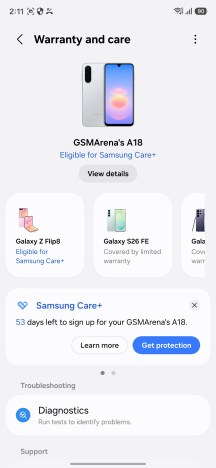
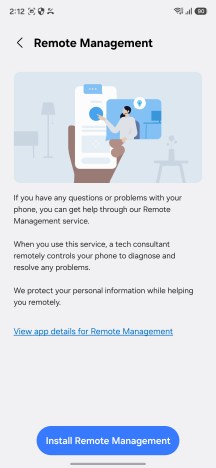
Warranty and care
Opening the Advanced Features settings menu we find a surprising number of features.
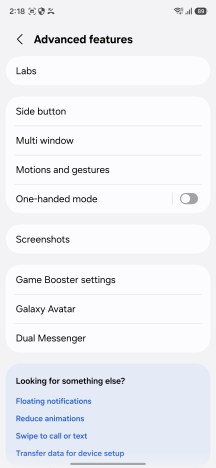
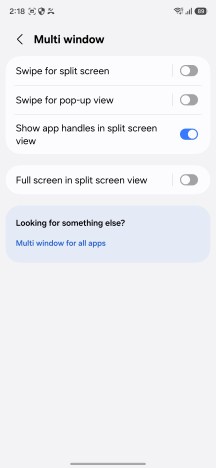
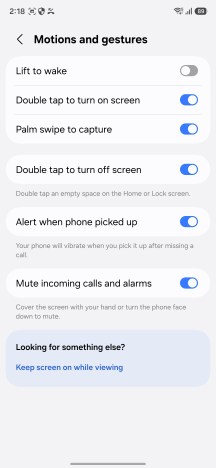
Advanced features menu
The Connected devices menu is also encouragingly full of things. Some things like DeX are missing or at the very least hidden, but you can still do wireless casting, you can link to windows, there is Multi control and Continue on other devices. Android Auto and the new Driving report menu are also present. Not too shabby at all.
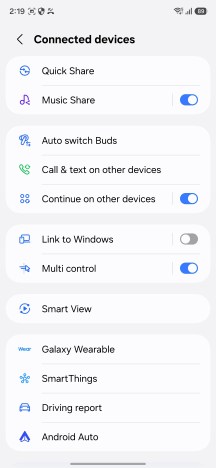
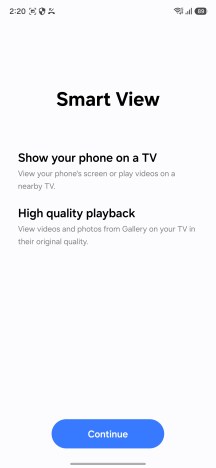
Connected devices menu
One thing notably missing is most of the AI that you would see on a Galaxy S-series phone. Galaxy AI is kind of missing altogether. No Bixby or Perplexity. At least not in any obvious way. Even the AI editing features in the Gallery app appear to be gone. It's understandable as real local AI models will struggle on 4GB of RAM and Samsung can't just give away all of the cloud compute on budget devices. Even Samsung's Now Brief is absent with the standard Google feed in its place.
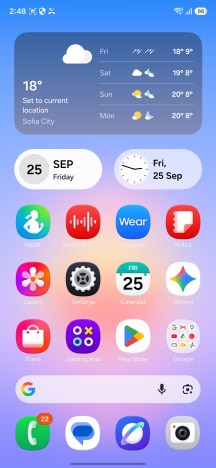
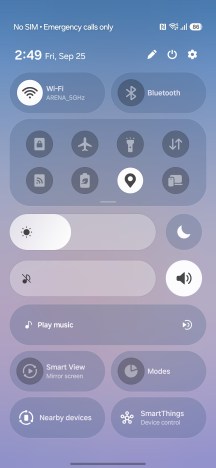
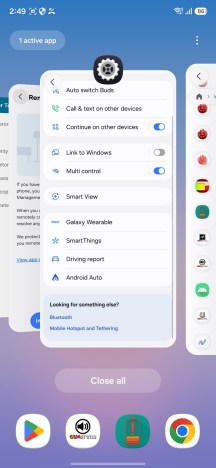
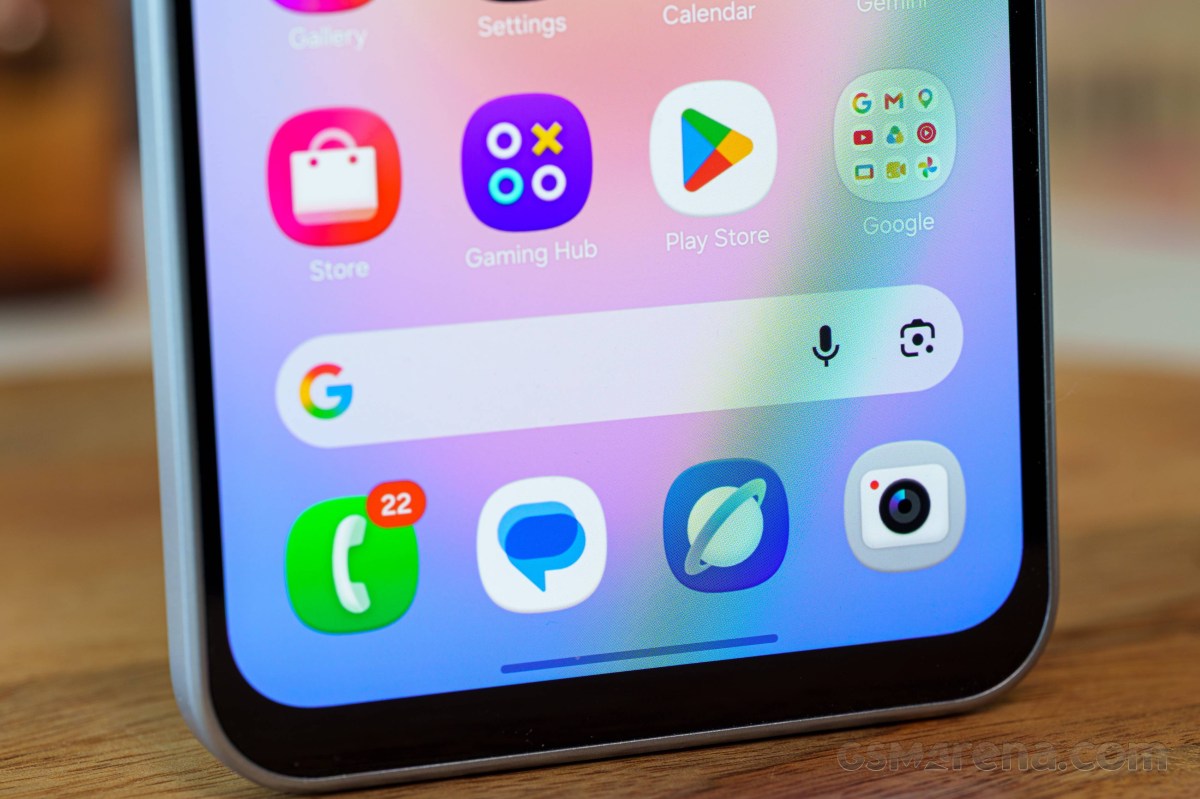
Home screen • Quick toggles • Recent apps
As for the general UI, not a whole lot has changed. If you've used a Samsung recently, you should feel right at home. There is a bit more customization here and there, which is nice. For example, you can now make the brightness and volume sliders on the quick toggles area taller.
Benchmarks and performance
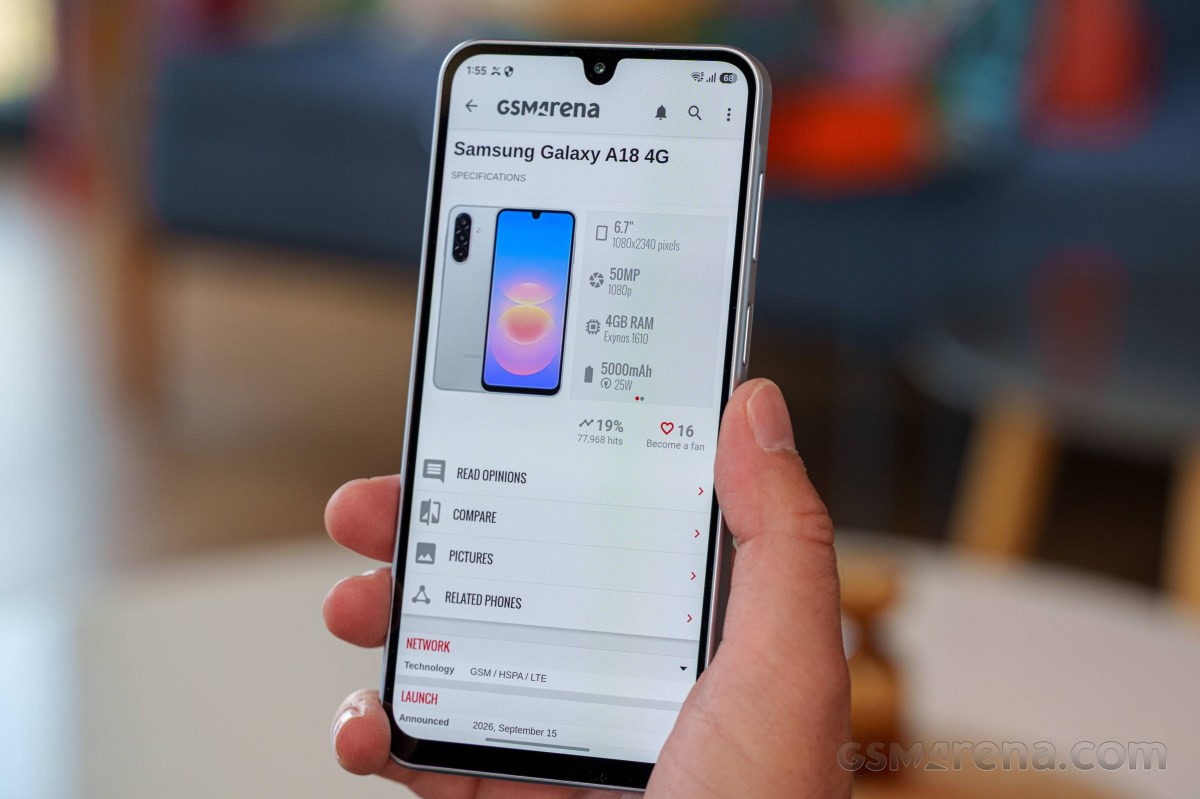
After sticking with the popular MediaTek Helio G99 for both the 4G variants of the Galaxy A17 and Galaxy A16, Samsung now decided to use its own in-house silicon as well. In particular, the A18 4G debuts the Exynos 1610. Many were quick to just write it off as a "4G variant of the Exynos 1280 or the Exynos 1330" and while there is some merit to such labeling, we dug into the matter and kernel source code teardowns prove that the Exynos 1610 (codename S5E8365) features a completely modified pipeline and is not merely a "rebrand" or a mere "modem swap".
Samsung upgraded the ISP for the 1610 compared to the older Exynos 1280 - that one could only do 4K@30fps video capture while the 1610 happily records 4K@60fps. The Galaxy A18 4G can't even do 4K@30fps - true, but we are talking theoretical technical capabilities here not what Samsung decided to artificially impose as a limitation for market segmentation reasons.The multimedia format codec (MFC) has been updated to include wider hardware decoding support, notably adding native VP9 decoding. There are technically devices out there with the Exynos 1280 that do offer official 4K video capture, so maybe the Exynos 1610 will eventually od the same inside a slightly higher end Galaxy A device. By the way, before you ask, we did try to "unlock" 4K on the A18 4G though Open Camera and had no success.
As for the 1330 comparisons: beyond the obvious 5G connectivity, we wouldn't say the Exynos 1330 is substantially better than the Exynos 1610 in any way. Even if the 1330 supports faster LPDDR5 RAM, while the Exynos 1610 caps out at LPDDR4X - them being exclusively used in budget smartphones (like the Galaxy A14 5G and A17 5G), Samsung almost always pairs it with slower LPDDR4X memory in practice to cut costs. On top of that, there is the GPU situation, the Exynos 1330 uses the same Mali-G68 GPU as the Exynos 1610 but with only two cores as opposed to four cores (as far as we can tell) in the Exynos 1610 (and the Exynos 1280 as well).
So, what we have here in the Exynos 1610 is a budget 4G chipset made on a familiar 5 nm (Samsung 5LPE) node with a familiar CPU setup, consisting of two 2.4GHz Cortex-A78 cores and six 2.0GHz Cortex-A55 cores and a familiar Mali-G68 MP4 (we think) GPU. If you really want to compare it to one of the aforementioned older Exynos chips, we would definitely favor the 1280 comparison more. But, more on that in a bit.
The memory situation is potentially a bit weird. We couldn't find any official info on what RAM chips the A18 4G uses, but these are most likely LPDDR4X and the phone is only offered with 4GB of RAM - a bit on the low end, especially for a device that promises to still be around after six major OS updates. The Galaxy A17 4G and even the Galaxy A16 4G offered higher RAM variants, but here we get another consequence of ongoing chip shortage in 2026.
Which kind of leads us to the weird part - the storage. We found a few passing references to a 64GB variant of the A18 4G and even found an actual store listing for one. On the surface, the existence of a 64GB base A18 4G variant does sound sadly plausible. Worse still, we reached out to Samsung and they indeed confirmed that a 64GB variant is reality for certain markets. However, they did not share any details on the types and class of chips used.
While some modern low-end chips retain legacy eMMC 5.1 support purely for ultra-cheap tablets or IoT devices, Samsung has completely standardized its internal storage pipeline on Universal Flash Storage (UFS) for its main smartphone lineup. Running modern Android 17 and One UI 9.0 on eMMC would result in paralyzing lag, meaning Samsung would never bottleneck their new chip with it.
So that means the elusive 64GB variant would kind of have to be UFS. Looking at Samsung Semiconductor's current official portfolio reveals that the company does still make and offer 64GB UFS chips. You will only find 64GB variants on older, highly stable iterations like UFS 2.1 and UFS 2.2. Samsung's high-speed lines (UFS 3.1, 4.0, and the upcoming 5.0) realistically start at a floor of 128GB or 256GB due to block-allocation mechanics and speed penalties associated with formatting advanced V-NAND into smaller capacities. These chips are not allocated for mainstream smartphones. Instead, they are produced for long-lifecycle segments, particularly automotive infotainment and ADAS modules, industrial automation, and entry-level IoT architecture where 128GB is cost-prohibitive or unnecessary. 64GB embedded Universal Flash Storage (eUFS) chips are specified for entry-level electronics, automotive dashboards, smart home hubs, and industrial devices where space/cost requirements are low and 128GB is unnecessary.
We are effectively paraphrasing Samsung Newsroom articles here, so bottom line, it is truly weird that a 64GB Galaxy A18 4G exists. Our review unit is a 128GB/4GB unit and there is definitely a 256GB/4GB version out there as well. Both, we remind you, with expandable storage.
That was a lot of rambling for what is essentially a budget chipset, we get it, but it is still an interesting one. Looking at some actual benchmark results, the Exynos 1610 inside the Galaxy A18 4G lands about where we would expect in the CPU department. That is to say, a bit above the MediaTek Helio G99 it kind of "replaces" this year and pretty much on par with the likes of the Exynos 1330 and Exynos 1280 we already mentioned as well as the Dimensity 7100 and the Snapdragon 6 Gen 3. Though the latter two have a slight edge in multi-come scenarios.
AnTuTu paints a similar picture - the Galaxy A18 4G is about on par with the likes of the Galaxy A25 and the galaxy A16 5G and A17 5G - hardly a powerhouse.
GeekBench 6
- Single-core
- Multi-core
 OnePlus Nord CE5












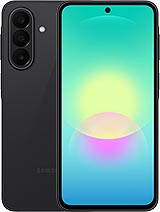
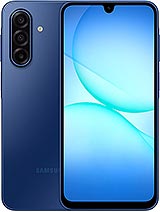
 Galaxy A16 5G
 Galaxy A25
 Galaxy A18 4G
 Redmi Note 14 5G
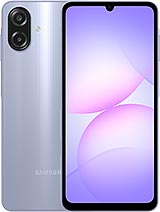 Galaxy A07 4G
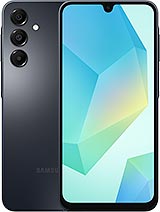 Galaxy A16 4G
AnTuTu
- v10
- v11
OnePlus Nord CE5
 Galaxy A36
 Galaxy A26
Galaxy A18 4G
Galaxy A25
Galaxy A07 4G
Galaxy A16 4G
3DMark
- Wild Life Extreme (Highest)
- Wild Life Extreme (Lowest)
OnePlus Nord CE5
 Infinix Note Edge
Galaxy A25
Galaxy A18 4G
 Moto G Power (2025)
Galaxy A07 4G
Galaxy A16 4G
Thermal-throttling
The Exynos 1610 is not a particularly powerful chipset but at least you don't have to worry about thermals. It doesn't realistically put out a lot of heat and practically never thermal-throttles, which is in contrast with any modern flagship chip.
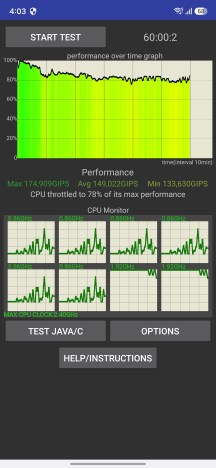
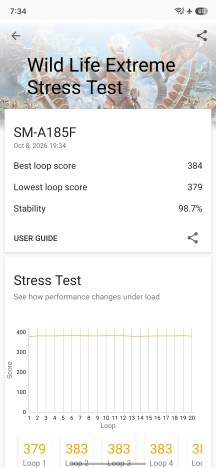
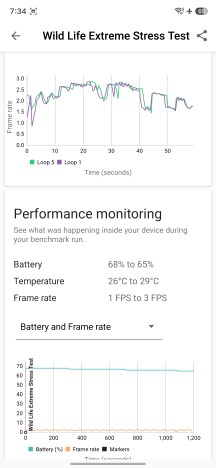
Thermal throttling
Whatever heat it does produce gets pretty seamlessly handled by the cooling solution. The phone never gets more than lukewarm.


Tip us
2.1m 180k
RSS
EV
Merch
Log in I forgot my password Sign up