Social climber
Xiaomi Mi 6 review: Social climber
Display
Much have changed since the Mi 5, but the display is not among the long list of upgrades. The Xiaomi Mi 6 uses a 5.15" IPS LCD with 1080p resolution. We're already used to seeing QHD screens on flagships but on a screen of this diagonal, we're quite content with 1080p as well.
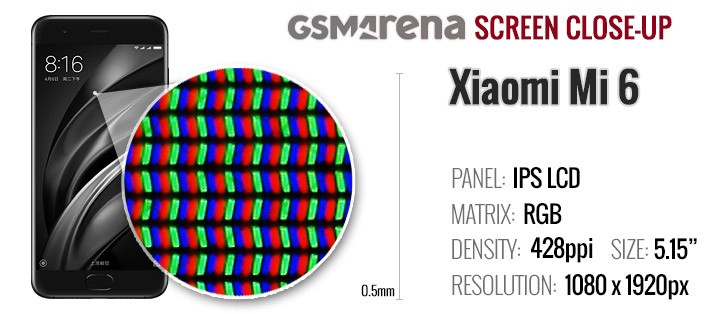
The pixel density of 428ppi is great and provides a very sharp image. Xiaomi promises 600nits of maximum brightness and 1500:1 contrast. Putting those claims to test, we can confirm we got exactly 603nits or maximum brightness. Unfortunately, the contrast ratio was not as good as advertised. Due to the not-so-deep blacks it only managed to achieve 1305:1, which is quite good too.
The Mi 6 offers a minimum brightness of just 1.2 nits, great for late-night reading.
| Display test | 100% brightness | ||
| Black, cd/m2 | White, cd/m2 | ||
| 0.462 | 603 | 1305 | |
| 0.51 | 628 | 1227 | |
| 0.51 | 660 | 1294 | |
| 0.44 | 637 | 1448 | |
| 0.416 | 592 | 1423 | |
| 0.46 | 500 | 1094 | |
| 0.35 | 561 | 1603 | |
| 0.40 | 656 | 1640 | |
| 0.00 | 391 | ∞ | |
| 0.00 | 563 | ∞ | |
| 0 | 440 | ∞ | |
| 0 | 618 | ∞ | |
| 0 | 447 | ∞ | |
| 0.228 | 468 | 2053 | |
| 0.277 | 564 | 2036 | |
The Xiaomi Mi 6 managed to surprise in our sunlight legibility test scoring as high as an AMOLED panel would.
Sunlight contrast ratio
-
Samsung Galaxy S8
4.768 -
Samsung Galaxy S8+
4.658 -
Samsung Galaxy S6 edge+
4.615 -
Samsung Galaxy S7 edge
4.439 -
OnePlus 3
4.424 -
Samsung Galaxy S7
4.376 -
HTC One A9
4.274 -
Samsung Galaxy Note7
4.247 -
Samsung Galaxy A3
4.241 -
OnePlus 3T
4.232 -
Google Pixel XL
4.164 -
ZTE Axon 7
4.154 -
Samsung Galaxy S6 edge
4.124 -
Samsung Galaxy A7 (2017)
4.124 -
Samsung Galaxy Note5
4.09 -
Huawei Nexus 6P
4.019 -
Vivo Xplay5 Elite
3.983 -
OnePlus X
3.983 -
Apple iPhone 7
3.964 -
Oppo R7s
3.964 -
Huawei P9 Plus
3.956 -
Meizu Pro 6 Plus
3.935 -
Lenovo Moto Z
3.931 -
Samsung Galaxy A7 (2016)
3.918 -
Samsung Galaxy C5
3.911 -
Samsung Galaxy C7
3.896 -
Samsung Galaxy A5
3.895 -
Samsung Galaxy J7 outdoor
3.879 -
Samsung Galaxy J2 outdoor
3.873 -
Samsung Galaxy A8
3.859 -
Sony Xperia XZs
3.818 -
Samsung Galaxy A9 (2016)
3.817 -
Motorola Moto X (2014)
3.816 -
Samsung Galaxy A5 (2017)
3.804 -
Samsung Galaxy J7 (2016) outdoor mode
3.802 -
LG V20 Max auto
3.798 -
Xiaomi Redmi Pro
3.798 -
Sony Xperia XZ
3.795 -
Samsung Galaxy A5 (2016)
3.789 -
Apple iPhone 6s
3.783 -
Meizu Pro 5
3.781 -
Microsoft Lumia 650
3.772 -
Xiaomi Mi 6
3.767 -
Samsung Galaxy J7 (2016)
3.756 -
Oppo F1 Plus
3.709 -
Vivo X5Pro
3.706 -
Samsung Galaxy A3 (2017)
3.688 -
Apple iPhone SE
3.681 -
Huawei Mate 9
3.68 -
Samsung Galaxy A7
3.679 -
Meizu PRO 6
3.659 -
BlackBerry Priv
3.645 -
Apple iPhone 7 Plus
3.588 -
LG G6
3.556 -
Apple iPhone 6s Plus
3.53 -
Motorola Moto Z Play
3.526 -
Samsung Galaxy J3 (2016) outdoor mode
3.523 -
Samsung Galaxy J3 (2016)
3.523 -
Acer Jade Primo
3.521 -
Microsoft Lumia 950
3.512 -
Oppo R7 Plus
3.499 -
nubia Z11
3.466 -
Huawei P10 Plus
3.456 -
HTC U Ultra
3.453 -
Samsung Galaxy J7
3.422 -
Meizu MX5
3.416 -
LG V20
3.402 -
Huawei P10
3.379 -
Oppo R9s
3.352 -
Honor 8 Pro
3.341 -
Oppo R7
3.32 -
Lenovo P2
3.316 -
Xiaomi Mi 5s
3.276 -
Nokia 6 (Chinese version)
3.244 -
Xiaomi Mi 5
3.24 -
Samsung Galaxy J2
3.235 -
Sony Xperia X Performance
3.234 -
Xiaomi Mi Note 2
3.228 -
Motorola Moto X Play
3.222 -
Oppo F3 Plus
3.218 -
Huawei Mate 9 Pro
3.206 -
Huawei P9
3.195 -
Lenovo Vibe Shot
3.113 -
Motorola Moto X Force
3.105 -
LG Nexus 5X
3.092 -
Huawei Mate S
3.073 -
Microsoft Lumia 640 XL
3.065 -
Sony Xperia XA1
3.012 -
Sony Xperia X
2.989 -
Huawei Mate 8
2.949 -
Xiaomi Redmi 3S
2.913 -
Sony Xperia XA Ultra
2.906 -
LG G5
2.905 -
HTC One S
2.901 -
Xiaomi Redmi 3s Prime
2.893 -
Xiaomi Mi 5s Plus
2.884 -
Sony Xperia XZ Premium
2.877 -
Sony Xperia XZ Premium (sRGB)
2.877 -
Sony Xperia Z5
2.876 -
Microsoft Lumia 550
2.851 -
Lenovo Moto M
2.813 -
Xiaomi Redmi 3 Pro
2.803 -
Sony Xperia Z5 compact
2.784 -
Meizu MX6
2.751 -
LG V10
2.744 -
Xiaomi Redmi 3
2.735 -
Xiaomi Redmi Note 4 (S625)
2.714 -
Meizu M5
2.71 -
Sony Xperia M5
2.69 -
Huawei P9 Lite
2.679 -
Xiaomi Redmi 4 Prime
2.679 -
Vivo V3Max
2.659 -
Xiaomi Mi Mix
2.658 -
Xiaomi Mi 4i
2.641 -
Sony Xperia XA
2.609 -
Motorola Moto G4 Plus (max auto)
2.582 -
Motorola Moto G4 Plus
2.582 -
Meizu M5s
2.58 -
Xiaomi Mi 4c
2.574 -
LeEco Le Max 2
2.567 -
Microsoft Lumia 640
2.563 -
Asus Zenfone 3 ZE552KL
2.563 -
Lenovo Moto G4
2.544 -
Lenovo K6 Note
2.544 -
Oppo F1
2.528 -
Sony Xperia Z5 Premium
2.525 -
Huawei Honor 7 Lite / Honor 5c
2.506 -
Sony Xperia M4 Aqua
2.503 -
Oppo F1s
2.481 -
Motorola Moto G
2.477 -
Lenovo Vibe K5 Plus
2.473 -
Huawei G8
2.471 -
Huawei nova
2.467 -
Sony Xperia Z
2.462 -
Lenovo Vibe K5
2.459 -
Meizu m3 max
2.447 -
HTC 10 evo
2.407 -
Huawei Honor 7
2.406 -
Sony Xperia E5
2.386 -
ZUK Z1 by Lenovo
2.382 -
Samsung Galaxy J5 (2016)
2.378 -
HTC 10
2.378 -
Oppo F3
2.376 -
vivo V5 Plus
2.371 -
Meizu m1 note
2.362 -
Huawei nova plus
2.329 -
HTC One E9+
2.305 -
Alcatel One Touch Hero
2.272 -
Lenovo Vibe K4 Note
2.254 -
Sony Xperia C5 Ultra
2.253 -
Xiaomi Redmi Note 3 (MediaTek)
2.249 -
Sony Xperia C4 Dual
2.235 -
Xiaomi Mi Note
2.234 -
Motorola Moto G (2014)
2.233 -
Huawei P8
2.196 -
Meizu M5 Note
2.189 -
Huawei Honor 6
2.169 -
Xiaomi Redmi Note 2
2.166 -
OnePlus Two
2.165 -
HTC One X
2.158 -
LG Aka
2.145 -
Xiaomi Redmi Note 4 (X20)
2.145 -
Archos 50 Diamond
2.134 -
Xiaomi Redmi Note
2.119 -
Xiaomi Mi 4S
2.095 -
Acer Liquid X2
2.084 -
Huawei P8lite
2.078 -
vivo V5
2.059 -
Moto G 3rd gen max manual
2.026 -
Xiaomi Mi 3
2.001 -
Xiaomi Mi Max
1.996 -
Sony Xperia E4g
1.972 -
OnePlus One
1.961 -
Meizu m3 note
1.923 -
BlackBerry Leap
1.892 -
Meizu m2 note
1.892 -
ZTE Nubia Z9 mini
1.759 -
Sony Xperia U
1.758 -
Asus Zenfone Selfie
1.68 -
Motorola Moto E (2nd Gen)
1.675 -
ZTE Nubia Z9
1.659 -
Jolla Jolla
1.605 -
Motorola Moto E
1.545 -
Sony Xperia M
1.473 -
Sony Xperia L
1.351 -
HTC Desire C
1.3 -
Meizu MX
1.221 -
Sony Xperia E
1.215
You can choose from three different options for the screen's color calibration. The default one is Automatic, which also optimizes the contrast dynamically in response to the available ambient light. When you use the phone in bright light, it would brighten up any dark on-screen areas to make them better legible.
The standard contrast mode doesn't have that but it offers very accurate color rendering with an average DeltaE of 3.2 and maximum deviation of 5.8 in the whites.
Finally, there is the Increased Contrast, which visually oversaturates all colors, in case that's your thing.
Additionally, there is a Reading mode similar to Apple's Night Shift. It removes the blue hues in line with recent trends as they potentially interfere with your sleep quality when you use the device just before bedtime. For extra convenience, you can configure this mode to be enabled only for selected apps.
Battery life
The Xiaomi Mi 6 has a sealed battery of 3,350mAh. That's a 10% improvement over the Mi 5. The phone supports Quick Charge 3.0 and the supplied charger can fill up to 55% of a depleted battery in 30 minutes.
We ran our battery test and the Xiaomi Mi 6 scored an 80h rating, which surprisingly is lower than the Mi 5's rating. The culprit is the Mi 6's relatively high power draw in standby mode because otherwise, it scored better in the three individual test of calling, web browsing and video. This unusual power consumption in standby might be software-related and fixed with a future update.
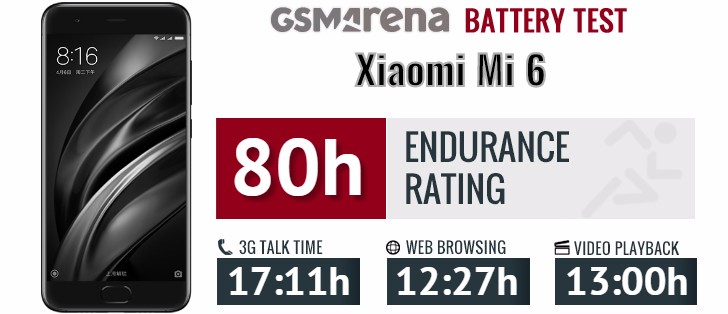
Our endurance rating stands for how long a single battery charge will last you if you were to use the Xiaomi Mi 6 for an hour each of telephony, web browsing, and video playback daily. We've established this usage pattern so our battery results are comparable across devices in the most common day-to-day tasks. The battery testing procedure is described in detail in case you're interested in the nitty-gritties. You can also check out our complete battery test table, where you can see how all of the smartphones we've tested will compare under your own typical use.
Connectivity
The Xiaomi Mi 6 is well-stocked with connectivity options, mostly due to the well-equipped Snapdragon 835 SoC. The Mi 6 offers LTE at Cat. 16 with impressive 1Gbps of download, courtesy of the latest Qualcomm modem with 3x carrier aggregation.
Unfortunately, unlike other flagships, the Mi 6 has very limited LTE support of just 9 bands. While it supports the widespread band 3 and 7, it omits band 20, which may be a problem in some EU countries. So, if you consider the Mi 6 and you want to use LTE networks, just make sure it supports your local band before you buy.
The Xiaomi Mi 6 also comes equipped with dual-band Wi-Fi a/b/g/n/ac with 2x2 MIMO antennas for speeds up to 867Mbps (if you have a compatible router). The local connectivity list goes on with Bluetooth 5.0 with aptX and Low Energy, and NFC.
The Wi-Fi connection can be used for screen casting - be it Miracast, Google Cast, or DLNA.
GPS, GLONASS, and BeiDou satellite positioning systems are supported, but apparently, the Mi 6 omits Galileo support.
The Xiaomi Mi 6 has no FM radio. There is no audio jack either, but Xiaomi provides a proper USB-C-to-analog jack adapter.
The USB port is Type-C but we can't confirm whether it's 2.0 or 3.x. Still, it lets you hook up USB storage and accessories and charge other devices.

Tip us
1.7m 126k
RSS
EV
Merch
Log in I forgot my password Sign up