OnePlus 15 review
Triple 50MP camera setup
A few major changes are coming to the camera setup with this year's OnePlus 15. First and foremost, the company is ditching the Hasselblad branding on its camera. Secondly, the camera hardware has been notably downgraded. All three cameras on the back have been downgraded to smaller sensors.
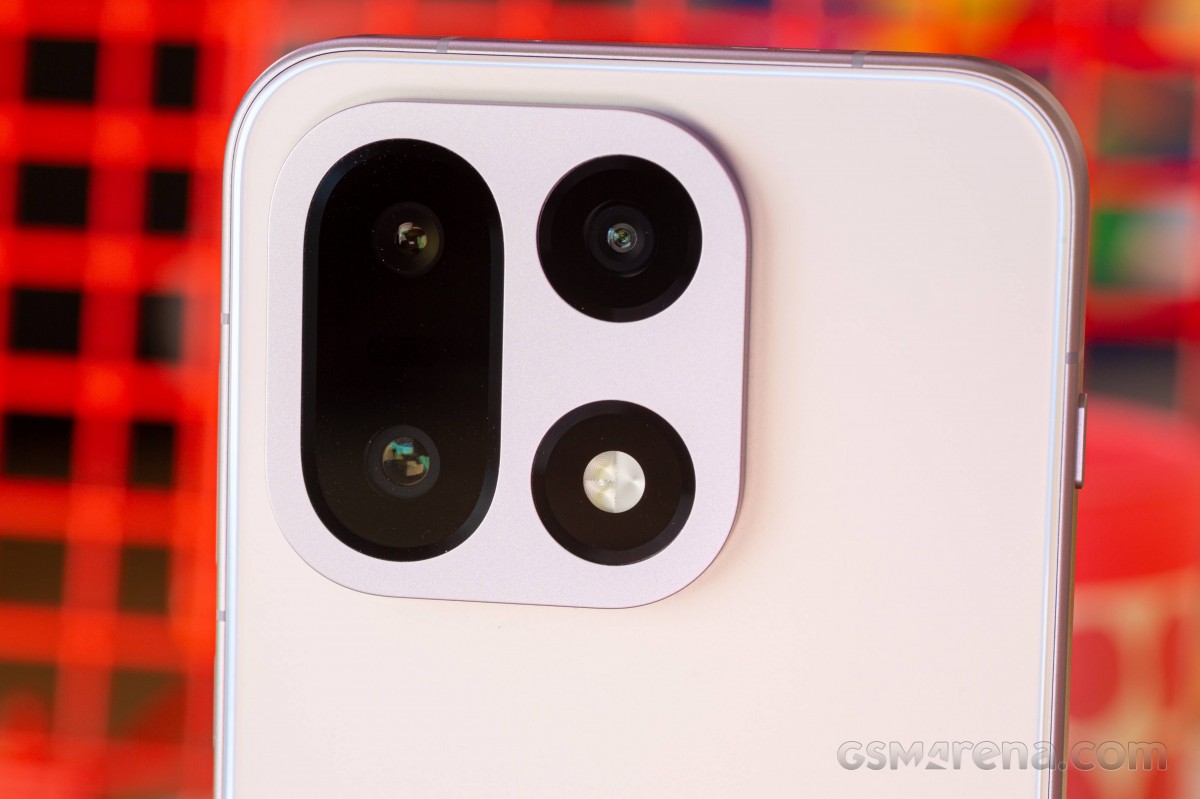
Additionally, the telephoto and main cameras get a smaller aperture, and the ultrawide shooter offers a narrower field of view. At least the telephoto unit upgrades the optical zoom to 3.5x, and the selfie camera gains autofocus. The selfie is also using a new RGBW Sony sensor.
- Wide (main): 50MP Sony IMX 906, f/1.8, 1/1.56", 23mm, 1.0µm PDAF, OIS; 8K@30fps.
- Telephoto 3.5x: 50MP ISOCELL JN5 (S5KJN5), f/2.8, 1/2.76", 85mm, 0.64µm, PDAF, OIS; 4K@120fps.
- Ultra wide angle: 50MP OmniVision OV50D, f/2.0, 1/2.88", 0.612µm, 16mm, 116° FoV, AF; 4K@60fps,
- Front camera: 32MP Sony IMX709, f/2.4, 1/2.74", (0.64µm-1.28µm), 21mm, AF; 4K@60fps
However, OnePlus promises to offset those downgrades with software trickery. For instance, the DetailMax Engine debuts with the OnePlus 15. When you enable the High-resolution toggle in the camera settings, the system will output 26MP images, up from the natively binned 12.5MP photos. OnePlus promises sharper, more detailed photos with wider dynamic range by stacking multiple 12MP images with a 50MP image. The DetailMax Engine works with the main and telephoto cameras.
Video recording capabilities have also been improved. It's one of the few phones on the market that can record 4K videos 120fps in compliance with the Dolby Vision HDR standard.

The 15 is also getting real-time tone mapping. It intelligently isolates the subject from the background, applying tonal adjustments in real time.
Last but not least, OnePlus 15 not only supports Log video recording using the company's proprietary O-Log color space, but also has a live LUT preview, meaning you can see a color-graded preview of the footage you are taking in real time.
Daylight photos
Main camera
For this review, we've been using the 26MP High-resolution shooting mode as the default. We discovered that the system would often switch back to "Standard" 12MP resolution when it sees fit, so most of our indoor and all of our low-light photos are 12MP.
At first glance, these 26MP photos get you a wide dynamic range and lively, but not over-the-top colors. However, upon closer examination, the detail and sharpness are not very good to the point of reminding us of an upper midrange phone and not a flagship cameraphone. Some areas of the image look overprocessed.










26MP main camera daylight photos
Compared to the 26MP photos, the 12MP images appear sharper with better contrast and rendition even if they are a bit more processed. You also seem to get better dynamic range due to the improved HDR algorithms at this resolution. Honestly, the 26MP mode feels like a gimmick here, so you are better off leaving the default "Standard" image format as is.
















Main camera: 12MP • 26MP
And here are a few more 12MP photos.




12MP main camera photos
The 50MP photos look fine considering you are not supposed to shoot at full res with a Quad Bayer sensor anyway.




50MP main camera photos
Photos of people look very good. They are not terribly sharp, but they have nice colors and a wide dynamic range.








People shots: Photo mode • Portrait mode
2x crop zoom
The 2x crops from the main camera will always turn out in 12MP resolution. They have about as good image quality as the 26MP photos - decent, but not great, especially with more distant objects.














2x crop daylight photos
Here are some 2x zoom photos of people.








2x people shots: Photo mode • Portrait mode
3.5x telephoto camera
Again, most pictures from the 3.5x telephoto camera are 26MP, but this camera is even more eager switch down to 12MP, sometimes even in broad daylight.
In any case, the end result is better than we initially expected from the given hardware. The photos are sharp and detailed. The contrast and colors are great, and even fine detail in the shadows is rendered very nicely.








3.5x telephoto camera daylight photos
Comparing the 12MP photos to the 26MP ones, we find the 26MP at the same level of sharpness, dynamic range, contrast, and colors, so you only get the net benefit of the higher resolution and more detail. We often found ourselves leaning toward the 26MP mode, but it has its missteps too.
















Telephoto camera: 12MP • 26MP
And here are a few more 12MP photos.








12MP telephoto camera photos
And the zoomed photos of people are great too - with exemplary detail and skin tone rendition.








3.5x people shots: Photo mode • Portrait mode
7x crop zoom
OnePlus put a 7x toggle in the viewfinder, and the quality of digital crops is quite good. You can snap some really nice zoomed shots if there is enough light.












7x crop zoom daylight photos
Ultrawide camera
As far as ultrawide cameras go, the photos here are above average. Sharpness and detail are nice, but colors are somewhat muted compared to the other two cameras.












Ultrawide camera daylight photos
Macro mode
There's also a macro mode that uses the main cam, not the telephoto shooter. We can't say we are impressed by the results, but some of the shots look very good, keeping in mind they are, in fact, a 3.5x digital zoom. We still wish the telephoto camera could focus from closer than 30cm.






3.5x macro photos
The 7x toggle is also present in the dedicated macro mode, but the close-ups are far from ideal. They lack fine detail and are very soft.






7x macro photos
Low-light photos
Main camera
The system triggers the Night mode automatically so pretty much all of the low-light photos we took are shot with the Night mode on.
The photos are more than decent - clean, sharp and fairly detailed with wide dynamic range. Colors are conservative, but not bleak. We only think that contrast could use a little boost in some of these.









Main camera low-light photos
The overall processing is a bit over the top, though, as there's a lots of artificial-looking rendering in the shadows, which in turn are often overexposed. Last but not least, the color temperature is also a bit off, with some warm light sources leaning toward a green-ish tint.
2x crop zoom
The low-light 2x crop zooms from the main camera are generally clean, but they lack any fine detail.








2x crop low-light photos
3.5x telephoto camera
The 3.5x telephoto produces nice photos after dark. They are clean and have good dynamic range. There is a lot to be desired in terms of definition, but we are okay with the results.









3.5x telephoto camera low-light photos
7x crop zoom
Unsurprisingly, things don't get any better at 7x crop zoom, and the textures become waxy and even a little blurry. The only way these photos can pass is if you are only viewing them on the phone's screen without any zooming.









7x crop low-light photos
Ultrawide camera
In the context of ultrawide cameras, this one performs quite decently. The overall quality (sharpness, detail) is slightly above average. We would have liked to see higher color saturation and better dynamic range.









Ultrawide camera low-light photos
Selfies
Selfies come from a 32MP front-facing camera, which has a wide native field of view. The viewfinder offers three toggles - 0.6x, 1x, and 2x. We wish manufacturers would stop outputting 32MP images from a sensor that's supposed to be doing pixel-binning but 32MP is more marketable than 8MP.
Nevertheless, we are quite happy with the results here as the photos come out well-balanced and with nice skin tones and a wide dynamic range. Zooming in reveals that the images lack any fine detail, but if you only intend to view your selfies on your phone, these would serve the purpose just fine.









Selfies: 0.6x • 1x • 2x
Here are a few extra camera samples in the native ultra wide field of view.



Selfies (0.6x)
In case you are wondering how the OnePlus 15 fares against its predecessor the OnePlus 13, given all the camera hardware downgrades, go check out our dedicated camera shootout article.
Video recording
The OnePlus 15 can record 8K videos at 30fps using its main camera or 4K at 120fps, while the rest of the cameras support up to 4K@60fps. Notably, the telephoto shooter can also do 4K@120fps. All footage is electronically stabilized.
You can check out the playlist below, which includes multiple video samples.
The main camera's videos are great across the board. The videos are quite sharp, detailed and free of noise. Contrast is good, dynamic range is wide and colors are lively, but close to real life. This video camera really stands out in low-light. And video stabilization on the main cam does a solid job at smoothing out the footage even when walking.
The 2x crop zoom videos are both noticeably softer, but while the daylight one is quite usable, the low-light one isn't up to snuff.
We are pretty impressed with the 3.5x footage as well. Dynamic range is a bit limited and contrast is low on the low-light clip, but overall quality is quite dependable. Noise isn't all that noticeable at night and there's plenty of detail to go around. We just wish it had better stabilization.
The 7x crop videos are pushing the boundaries of the small sensor. Both the low-light and daylight videos are generally soft and fuzzy-looking.
And finally, despite the limited dynamic range and slightly muted colors, the ultrawide video is pretty okay in daylight. We can't say the same for the low-light footage, though, as it's quite noisy and soft.


Tip us
2.1m 180k
RSS
EV
Merch
Log in I forgot my password Sign up