Motorola Razr 70 Ultra/Razr Ultra 2026 review
No major changes, solid dual setup
The Razr 70 Ultra doesn't change much in what was already a quite capable camera system on the previous model. You're getting a dual setup on the cover (wide and ultrawide, no tele), and an internal selfie camera for completeness' sake.
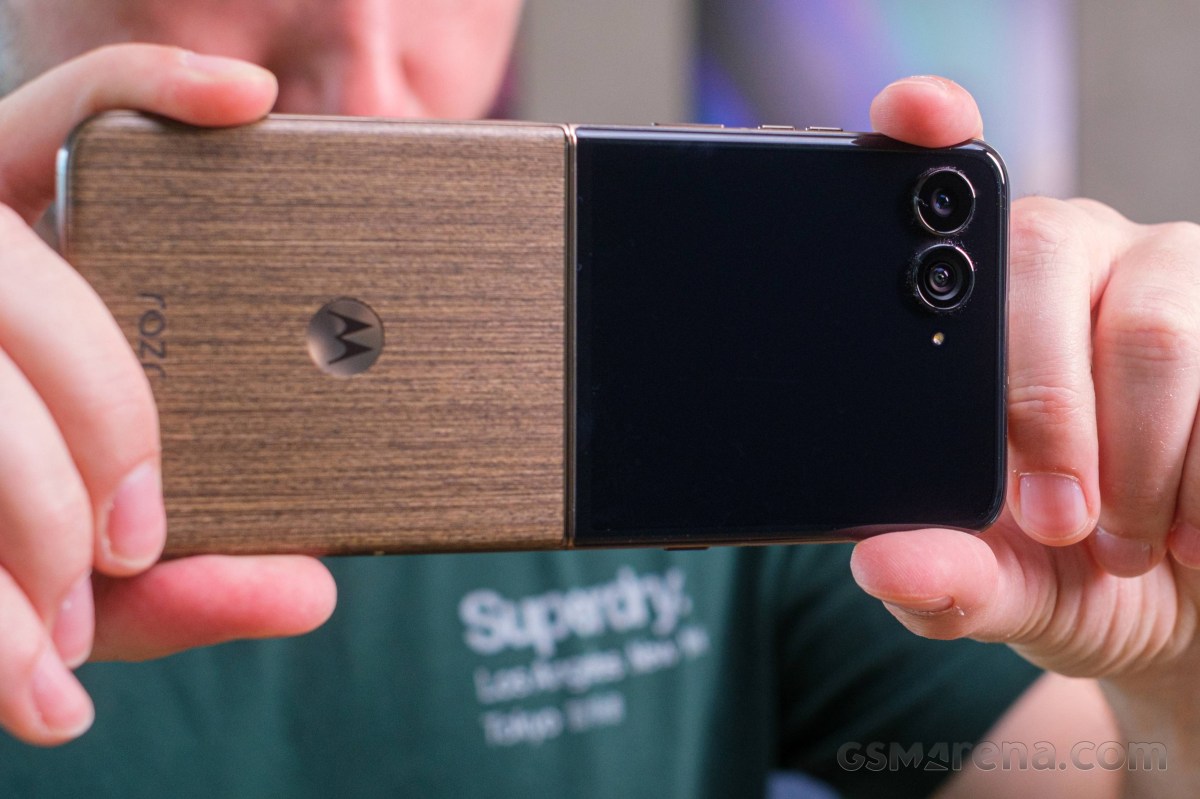
The main camera might just be new this time around - the phone reports an OmniVision OV50T sensor, in place of the Samsung GNJ found on last year's model. It's the first time we encounter this OV50T and there's not much information on it online, but the key specs are clear, and it's a 50MP 1/1.56" imager like the one on the predecessor. What does set it apart is its Lateral Overflow Integration Capacitor (LOFIC) technology, which "delivers up to 6x more dynamic range than the previous generation", Motorola says.
The ultrawide camera appears entirely unchanged though, with the same 50MP Sony sensor and AF-capable ultra-ultrawide 12mm equivalent lens.
The selfie camera has been carried over as well - another 50MP sensor (this one from Samsung, so all three big names are represented), paired with a fixed-focus lens.
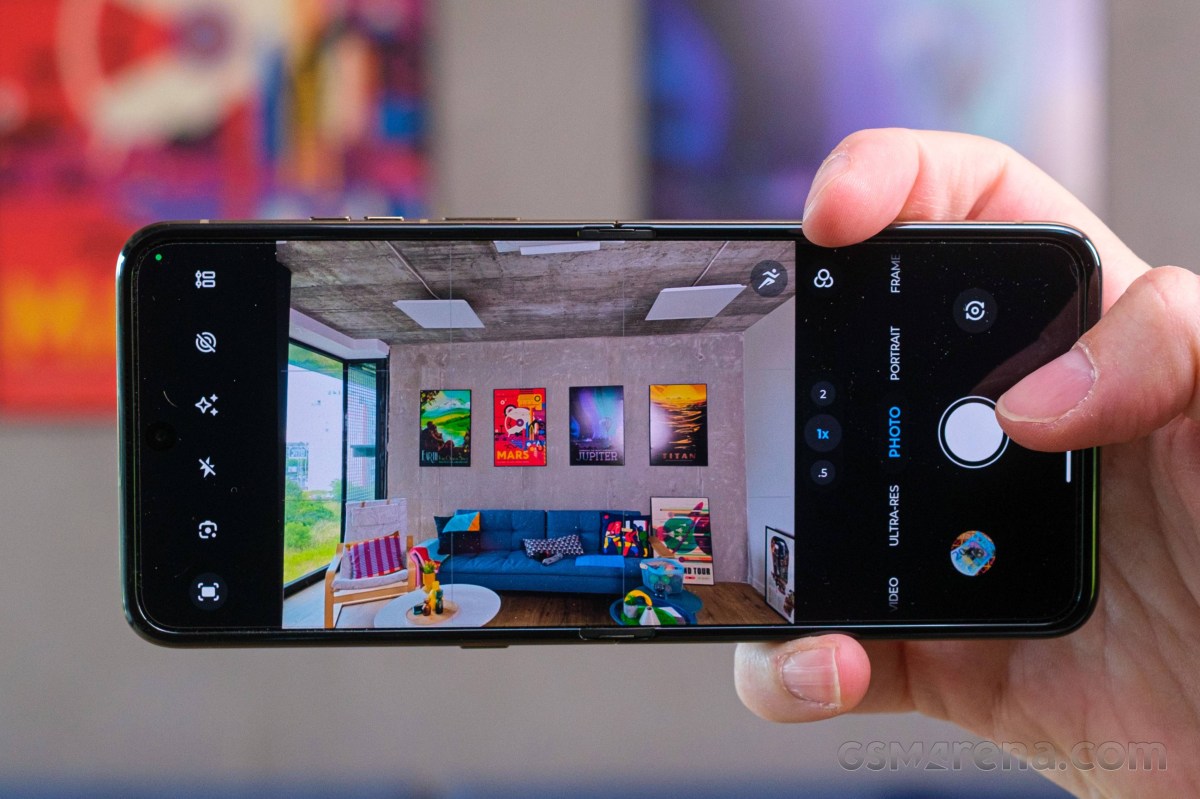
- Wide (main): 50MP OmniVision OV50T (1/1.56", 1.0µm-2.0µm); 22mm, f/1.8, OIS, PDAF; 8K30/4K60 video recording.
- Ultrawide: 50MP Sony IMX 816 (Lytia 500, 1/2.93", 0.6µm-1.2µm); 12mm, f/2.0, PDAF; 4K60.
- Front camera: 50MP Samsung ISOCELL JNS (S5KJNS, 1/2.76", 0.64µm-1.28µm); 22mm, f/1.9, fixed focus; 4K60.
You can operate the cover cameras from the cover screen, of course, and you get options to switch modes and change some relevant settings. The default behavior is tap anywhere to shoot, which seems straightforward enough. You still can't really zoom in beyond 1x though - not with pinching, not with tapping on the zoom button. We can imagine someone needing this missing option when using the phone propped up in tent mode on a table from across the room.
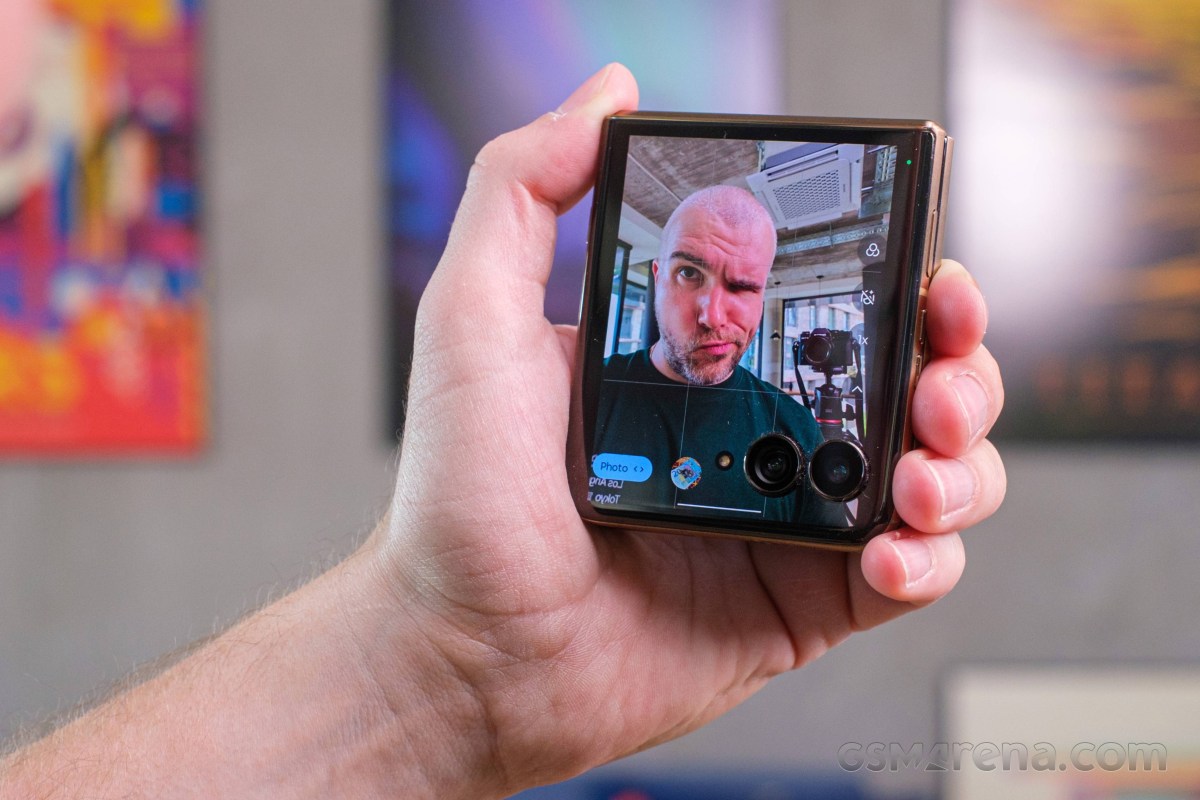
Naturally, the usual foldable-related use cases are also on the menu, including a split-screen interface for waist-level or overhead shooting. The 'camcorder' mode, where you can hold the Razr half-folded, mimicking a video camera from the 90s, is also here.
Daylight photo quality
Main camera
The Razr 70 Ultra takes excellent photos with its main camera in daytime. They have plenty of contrast (perhaps a touch too much), but also well-developed tonal extremes, and the vibrant take on colors completes an easily likable overall look. Detail is great too, with a reasonable amount of sharpening and a generally pleasing random texture rendition.








Daylight samples, main camera (1x)
People are also rendered nicely, with lifelike skin tones and great facial detail. The wide lens means you should be careful not to frame subjects too off-center though, because you'll get some distortion otherwise. We got very good Portrait mode results at 24mm too - subject detection works well, the bokeh effect is well judged, and both of these aspects are improved compared to what we got on the Razr 60 Ultra.






Human subjects, main camera: Photo mode (1x) • Portrait mode (24mm)
We see no reason to use the 50MP mode on the main camera, and here's a handful of samples to illustrate why - there's no extra detail, just bigger detail and heavy sharpening.




Daylight samples, main camera (1x), 50MP
When it comes to 2x zoom from the main camera, the Razr 70 Ultra just might be a step back from the Razr 60 Ultra's results. We are still getting very good detail here, but it's a bit more artificial and processed-looking than what we had on the previous model. Global properties remain excellent, of course.








Daylight samples, main camera (2x)
People shots at 2x aren't half bad either, whether in Photo mode, or in Portrait mode. We'll once again note that the Portrait mode's subject rendition and default blur properties are better than on last year's model.






Human subjects, main camera: Photo mode (2x) • Portrait mode (50mm)
Ultrawide camera
We'd also say that the ultrawide has an edge in sharpness over the one on the Razr 60 Ultra - the old model was a good performer in that respect, this one is a little better. Colors and dynamic range are excellent - these are certainly not bland images, but they're not cartoonish either. It's also worth pointing out that the lens is on the wider end of the ultrawide range, so you can have extra coverage or distorted perspectives.








Daylight samples, ultrawide camera (0.5x)
Again, though, we don't have much good to say about the 50MP versions of the above images.




Daylight samples, ultrawide camera (0.5x), 50MP
Close-ups
The ultrawide will focus very close, but it's hardly ideal for 'macro' shots - you'll be throwing a shadow on your subject or disturbing it in the process. You'd be a lot better off shooting on the main camera at 2x.




Close-up samples, ultrawide camera (0.5x)




Close-up samples, main camera (2x)
Low-light photo quality
Main camera
The main camera's exemplary performance at its native focal length continues into the night. We're looking at well-exposed photos with excellent dynamic range. The auto white balance copes with mixed lighting well, and the pleasing saturation we witnessed during the day remains a fixture in the low-light results. Detail is great too, and there's no night mode watercolor effect of excessive sharpening.








Low-light samples, main camera (1x)
The 2x results aren't quite as exciting, the overly liberal sharpening battling the inherent softness. Still, as 2x results from a wide camera go, these are quite alright, particularly for a clamshell foldable.








Low-light samples, main camera (2x)
Ultrawide camera
The ultrawide's low-light photos are good without truly shining. There's an improvement in dynamic range, especially in the highlights, and the color saturation is better than on the 60 Ultra, where things could look a little anemic. Detail is good overall, but shadows can be murky.








Low-light samples, ultrawide camera (0.5x)
Selfies
The almost unnecessarily good internal selfie camera of the Razr 60 Ultra makes a comeback on the 70 Ultra, and it takes even better photos now with even finer detail. Colors are quite nice too, and dynamic range is great, plus even the low-light results are pretty solid. It is missing AF, so for silly up-your-nose shots, you will still ultimately need the cover cameras.






Selfie samples, internal camera
The main camera is probably ideal for those, but it's also pretty great for general-purpose selfies. It will get you better subject separation thanks to the shallower depth of field, and it will ultimately treat you to higher quality results in terms of sharpness and color. It will be better in the dark too, naturally. Then there's the ultrawide, which will open up even more opportunities for unusual selfies.






Selfie samples, main camera (1x)




Selfie samples, ultrawide camera (0.5x)
Photo quality verdict
The Razr 70 Ultra proved to be a competent performer as a stills camera. Its main camera produces excellent results at its native focal length in all conditions, and it's also not bad at 2x - more so during the day, but also at night, within the context of the clamshell space. The ultrawide is also quite great during the day, but only good at night. The selfie camera on the inside is inside, but it's a little bit wasted since you'll probably just want to use the cover cameras for their extra quality and versatility.
Video quality
The Razr 70 Ultra can record video at up to 4K60 with all three of its cameras and the main one on the back adds an 8K30 option as well. There's still no 24fps option and no Pro video mode either.
The default codec is h.264 but you can flip a toggle to change it to h.265. Dolby Vision capture is available too, on both rear cameras up to 4K60.
There's always-on video stabilization, and there's also a horizon lock mode that works using the ultrawide cam at 1080p30.
You can hit '> play' below and use the '>| next' button to advance through the playlist of all video samples, or you can watch the full playlist on YouTube.
4K30 clips from the main camera at 1x are good overall. Detail is alright, dynamic range is good, and colors are vivid though the white balance might be a little off. The 2x results are pretty soft, but you can call them usable. The ultrawide is a bit extreme with its contrast and saturation, but it goes well with its extreme coverage - it's all a bit over the top.



Video screengrabs, daylight: 0.5x • 1x • 2x
The low-light results from the main camera are quite good at 1x, showing good detail, wide dynamic range and accurate colors. Тhe ultrawide's footage is noisy and soft-ish and has limited dynamic range.



Video screengrabs, low light: 0.5x • 1x • 2x
We're not huge fans of the stabilization on the Razr 70 Ultra, which is an odd development given how we praised the Razr 60 Ultra in that respect. Things are somewhat shivery when shooting from a stationary position on the main camera, and walking shake is also not ironed out well, plus there's a bit of a jello effect going on if you look for it. The ultrawide's stabilization is pretty great though.
Video quality verdict
The Razr 70 Ultra can record 4K60 clips with all of its cameras, and it can do it in Dolby Vision at that, so it's pretty well specced as a camcorder. Video quality overall is merely alright, though, and the main camera's stabilization is a bit of a letdown.


Tip us
2.1m 180k
RSS
EV
Merch
Log in I forgot my password Sign up